publications
2024
-
 “Studying How to Efficiently and Effectively Guide Models with Explanations” - A Reproducibility StudyAdrian Sauter, Milan Miletić, Ryan Ott, and 1 more authorTransactions on Machine Learning Research, 2024
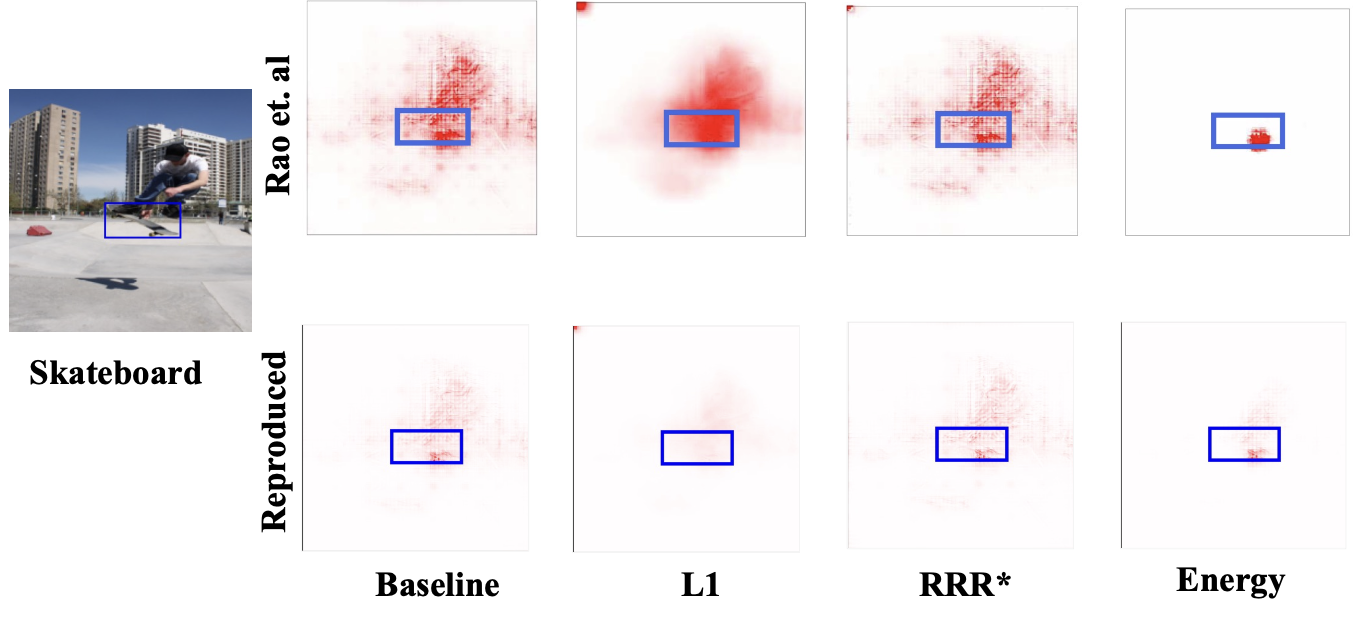
Model guidance describes the approach of regularizing the explanations of a deep neural network model towards highlighting the correct features to ensure that the model is “right for the right reasons”. Rao et al. (2023) conducted an in-depth evaluation of effective and efficient model guidance for object classification across various loss functions, attributions methods, models, and ’guidance depths’ to study the effectiveness of different methods. Our work aims to (1) reproduce the main results obtained by Rao et al. (2023), and (2) propose several extensions to their research. We conclude that the major part of the original work is reproducible, with certain minor exceptions, which we discuss in this paper. In our extended work, we point to an issue with the Energy Pointing Game (EPG) metric used for evaluation and propose an extension for increasing its robustness. In addition, we observe the EPG metric’s predisposition towards favoring larger bounding boxes, a bias we address by incorporating a corrective penalty term into the original Energy loss function. Furthermore, we revisit the feasibility of using segmentation masks in light of the original study’s finding that minimal annotated data can significantly boost model performance. Our findings suggests that Energy loss inherently guides models to on-object features without the requirement for segmentation masks. Finally, we explore the role of contextual information in object detection and, contrary to the assumption that focusing solely on object-specific features suffices for accurate classification, our findings suggest the importance of contextual cues in certain scenarios. Code available at: https://github.com/ryan-ott/model-guidance-reproducibility.
@article{sauter2024studying,
  title = {{\textquotedblleft}Studying How to Efficiently and Effectively Guide Models with Explanations{\textquotedblright} - A Reproducibility Study},
  author = {Sauter, Adrian and Miletić, Milan and Ott, Ryan and Prabakaran, Rohith Saai Pemmasani},
  journal = {Transactions on Machine Learning Research},
  issn = {2835-8856},
  year = {2024},
  url = {https://openreview.net/forum?id=9ZzASCVhDF},
}

2023
-
 Loci-Segmented: Improving Scene Segmentation LearningarXiv preprint arXiv:2310.10410, 2023
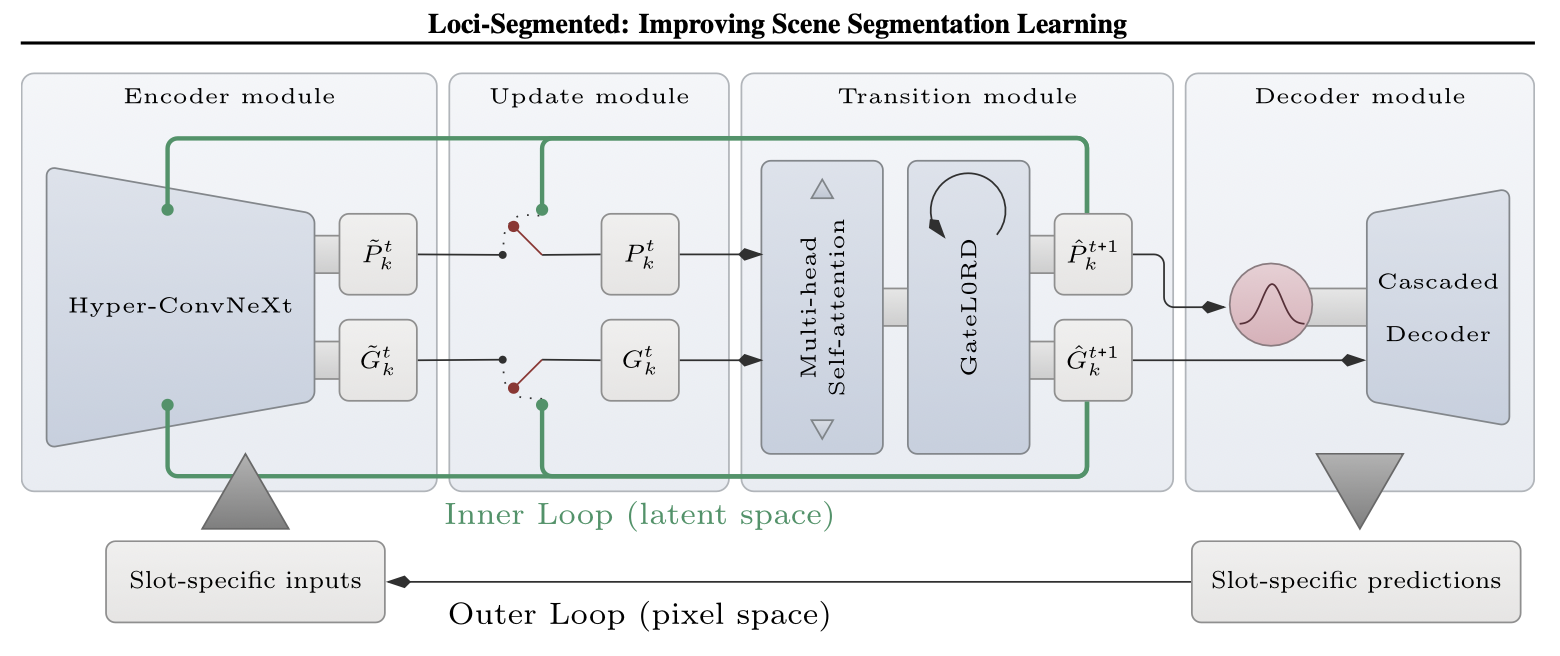
Current slot-oriented approaches for compositional scene segmentation from images and videos rely on provided background information or slot assignments. We present a segmented location and identity tracking system, Loci-Segmented (Loci-s), which does not require either of this information. It learns to dynamically segment scenes into interpretable background and slotbased object encodings, separating rgb, mask, location, and depth information for each. The results reveal largely superior video decomposition performance in the MOVi datasets and in another established dataset collection targeting scene segmentation. The system’s well-interpretable, compositional latent encodings may serve as a foundation model for downstream tasks.
@article{traub2023loci,
  title = {Loci-Segmented: Improving Scene Segmentation Learning},
  author = {Traub, Manuel and Becker, Frederic and Sauter, Adrian and Otte, Sebastian and Butz, Martin V},
  journal = {arXiv preprint arXiv:2310.10410},
  year = {2023},
}
